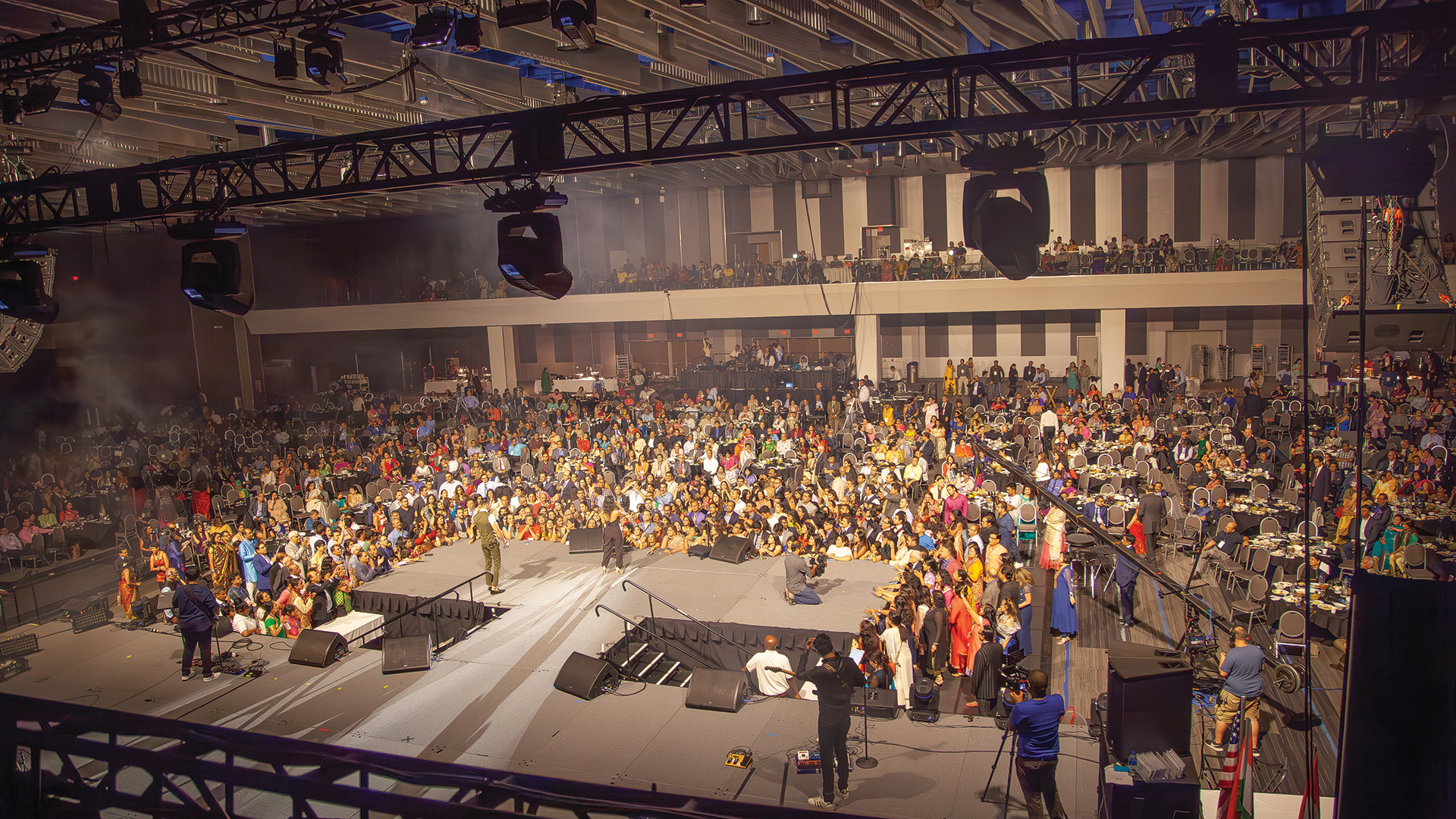
Hybrid events arrived as a necessity during the global shutdown of 2020, born from desperation rather than design. What the industry quickly discovered — through painful trial, burned reputations, and a thousand frozen video feeds — was that producing a compelling hybrid event demands an entirely separate production philosophy, not simply a webcam bolted onto an existing live event. The remote guest is not a second-class citizen to be tolerated; they are a distinct audience requiring dedicated infrastructure, dedicated personnel, and a production strategy that treats their experience as primary, not peripheral.
The Two-Show Problem
Every hybrid production is actually two productions running simultaneously, sharing a single stage but demanding separate technical chains. The in-room audience experiences the event through their senses — the house audio system, the physical energy of the room, the presence of other people. The remote audience experiences it through pixels and a speaker on their device, mediated by streaming encoders, CDN infrastructure, and whatever internet connection their home or office provides. A lighting look that reads beautifully from the third row may blow out the camera feed. A joke that lands in the room may fall flat on a stream delayed by 30 seconds of CDN latency.
Productions that fail to address this duality — that simply point a camera at the stage and call it hybrid — create a remote experience that feels like watching a foreign language film without subtitles: you’re present but you’re not included. Companies like Hopin, vMix, and Singular.live have built entire platform ecosystems around solving this problem with custom lower-thirds, interactive overlays, and real-time engagement tools that give remote audiences a distinct experience layer.
Network Infrastructure: The Non-Negotiable Foundation
The most common single point of failure in hybrid events is network infrastructure. Venue WiFi is not a production tool — it is a guest amenity, and treating it as your primary streaming backbone is a professional mistake. Dedicated wired connections with guaranteed QoS (Quality of Service) prioritization are the standard for serious hybrid productions. This typically means working with the venue’s IT department or bringing in a dedicated VLAN with its own bonded cellular backup through devices like the Haivision SRT Gateway or LiveU LU800 encoders.
The SRT protocol (Secure Reliable Transport), open-sourced by Haivision in 2017, has become the de facto standard for low-latency contribution feeds over unpredictable internet connections. Its built-in packet retransmission and AES-256 encryption make it the preferred transport for remote guest feeds, remote presenter connections, and outbound stream delivery. Pairing SRT transport with a cloud-based switching platform like AWS Elemental or Grabyo gives hybrid productions the redundancy and scalability that legacy RTMP-based workflows simply cannot match.
Remote Guest Kits and Technical Riders
One of the most persistent challenges in hybrid production is the uncontrollable nature of the remote guest’s environment. A keynote speaker dialing in from a hotel room with a ring light, a MacBook camera, and a spotty WiFi connection is not a production asset — they’re a liability. Professional hybrid productions address this by deploying remote guest kits: pre-configured packages containing a Logitech Brio or Elgato Facecam Pro webcam, a Rode NT-USB Mini or Blue Yeti X microphone, a portable LED panel, and a Speedify or Peplink Balance bonded cellular device.
Shipping these kits to speakers weeks in advance, paired with a technical pre-check session facilitated by a dedicated remote producer, transforms what would be an uncontrolled variable into a production asset. Organizations like the International Association of Exhibitions and Events (IAEE) have published hybrid event standards that explicitly recommend pre-show technical rehearsals for all remote participants — a discipline that was largely absent from the industry before 2020.
The Audio Challenge in Hybrid Settings
Audio is where hybrid productions most visibly fail. The fundamental problem is that room audio and broadcast audio are often mutually exclusive — what sounds natural in the room may pick up room reverb and HVAC noise that destroys intelligibility on the stream. Leading productions address this by separating the mix buses entirely: the FOH engineer manages the room experience while a dedicated broadcast mix engineer — running a parallel chain through consoles like the SSL System T or Calrec Brio — builds a separate broadcast mix optimized for headphone listening and compressed streaming audio.
For remote guest audio, echo cancellation is the primary technical battle. Platforms like Zoom, Teams, and StreamYard include algorithmic echo cancellation, but productions feeding remote guests into a live PA system need hardware-level solutions — units like the ClearOne CONVERGE Pro 2 or Shure IntelliMix P300 provide room-aware acoustic echo cancellation that prevents the PA from feeding back into the remote guest’s microphone feed.
Building a Hybrid Production Crew Structure
A hybrid event demands crew roles that didn’t exist five years ago. The remote producer — responsible for all aspects of the virtual experience — is now as essential as the show caller. The stream technician monitoring encoder health, CDN delivery, and latency metrics via tools like Mux Data or Conviva is a dedicated position, not a secondary responsibility assigned to the video technician between camera cuts. The virtual audience moderator managing chat, Q&A, and poll engagement on platforms like Slido or Mentimeter is a distinct creative role.
The hybrid event format is not a temporary compromise — it is the future of large-scale production. The audience is now permanently bifurcated, and the productions that thrive will be those that build dedicated workflows, dedicated crews, and dedicated budgets for the remote experience rather than treating it as an afterthought bolted onto a traditional live event model. The technical complexity is real. The creative opportunity is even larger.
