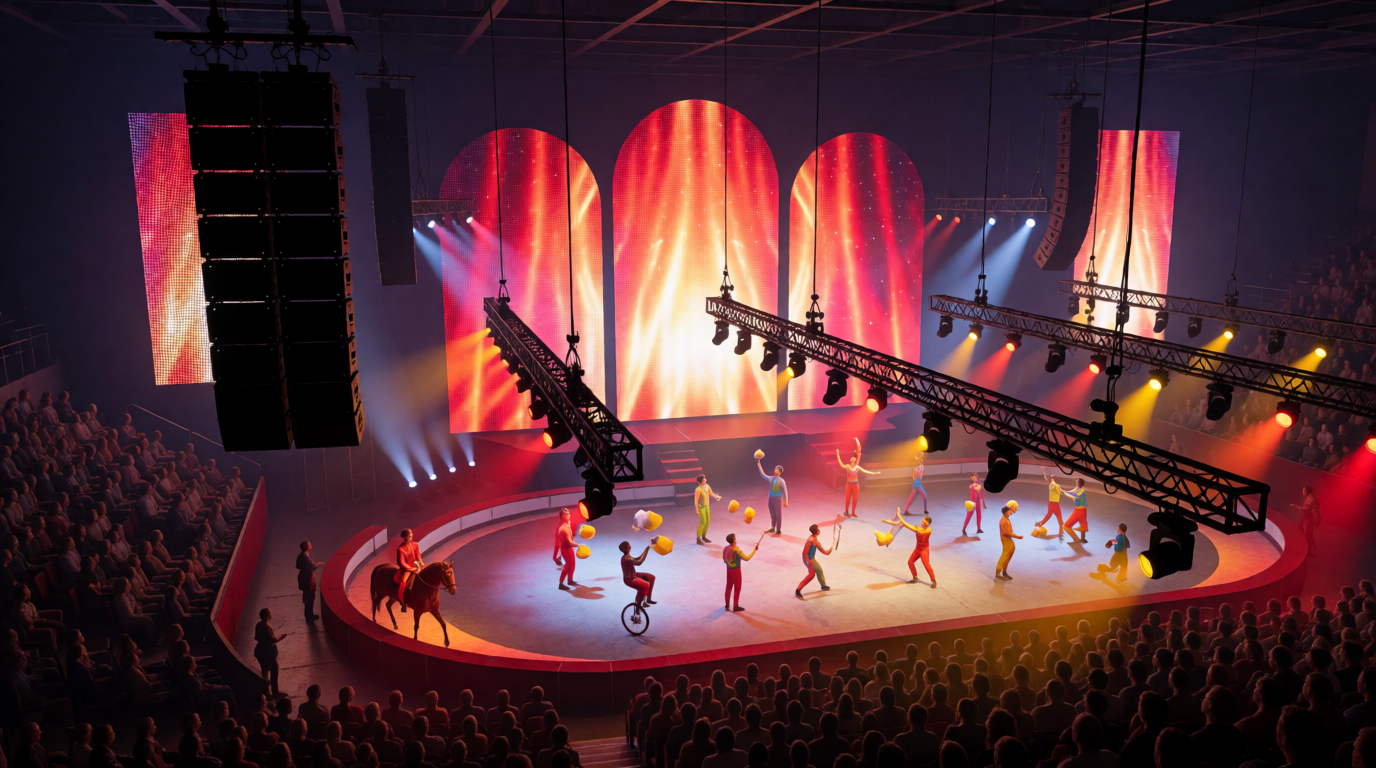
At 3:10 on a gusty Saturday afternoon, the production manager of a mid-size outdoor festival walked across a wet field with a clipboard, a walkie-talkie and a very specific look on his face. The look said: the headliner goes on at nine, the sponsors are on site, and nobody is touching those PA towers. Forty feet above him, sixteen boxes of a flown line array swayed on their pickpoints like wind chimes in a bad mood. The audio crew chief looked at the anemometer reading 31 mph, looked at the production manager, and said four words that have saved more careers than any résumé: “We’re bringing them down.”
That standoff is the quiet drama behind every outdoor show. The towers did stand up to management, literally and figuratively, and the crews who understand why have built the most resilient live event production businesses in the trade. This is the story of how a pile of steel, aluminum and amplifier racks became the loudest voice in the room.
From Wall of Sound to Wall of Liability
Every concert sound system owes something to the Grateful Dead’s Wall of Sound, built in 1974 by Owsley Stanley and Dan Healy with Alembic. It stacked 604 speakers behind the band and drove them with roughly 26,400 watts, and it was so enormous and so expensive that the band retired it after a single year. Before that, the sonic template had been Bill Hanley’s “It” system at Woodstock in 1969, a rig that proved you could push clean sound across a muddy pasture if you were stubborn enough. Then came Shea Stadium in 1965, where the Beatles played over the stadium’s own baseball PA and could not hear themselves, a humiliation that helped birth the stage monitor as we know it.
The real revolution arrived in 1992, when L-Acoustics unveiled V-DOSC, the first commercially successful line array. Suddenly the tower was no longer a pile of horns waiting to topple. It was a coupled, curved, calculable column of sound, and calculable things attract engineers, insurers and lawyers in equal measure. By the time d&b audiotechnik, Meyer Sound, JBL Professional and Martin Audio had their own flagship arrays, the PA tower had become an engineered structure with a paper trail.
Why the Rigger Outranks the Run Sheet
The industry learned its hardest lesson in August 2011, when the stage collapse at the Indiana State Fair killed seven people and rewrote the conversation about weather action plans. The aftermath pushed promoters toward documented trigger points, and standards such as ANSI E1.21, the guideline for temporary structures used in outdoor entertainment, moved from the bookshelf to the production binder. Today a serious festival has a written plan that names who watches the sky, which wind speeds trigger which response, and, crucially, who has the authority to say stop.
The practical tip here is almost insultingly simple: put an anemometer at the height of the arrays, not on a pole by the production office. Wind speed climbs with altitude, and the number on the ground flatters you. Davis Instruments and Kestrel make rugged units, but the brand matters less than the discipline of logging the reading every fifteen minutes in the same notebook the stage manager uses for cues. A written log turns an argument about feelings into a conversation about numbers, and numbers are the only language a nervous promoter respects.
The Arithmetic of a Standoff
Behind the drama is plain wind load math. A cabinet like the L-Acoustics K2 weighs about 56 kilograms, so a sixteen-box hang is roughly 900 kilograms of aluminum, rigging and drivers, and every square meter of its face catches wind like a sail. Manufacturer prediction tools, namely L-Acoustics Soundvision, d&b ArrayCalc, Meyer Sound MAPP 3D and the JBL Line Array Calculator, will tell you the coverage and the mechanical limits of a hang, and each manufacturer’s rigging manual lists a maximum recommended wind speed, usually well below what a field feels like on a bad afternoon.
Ground-supported towers add a second variable: ballast. Tomcat ground-support towers, Layher scaffolding systems and purpose-built delay frames all depend on dead weight at the base, and a tower that is perfectly safe at 15 mph can become an uninsured sculpture at 35. The seasoned crew brings a spreadsheet, not an opinion. List the cabinet count, the total flown weight, the ballast per leg and the manufacturer’s wind limit, then put those four numbers on a single page and hand it to management before the first gust arrives.
Negotiating With the Suits Without Losing the Gig
Here is the business insight that separates survivors from cautionary tales: the safety argument is also the financial argument. A cancelled headliner set can cost six figures in refunds, penalty clauses and sponsor make-goods. A collapsed array costs far more, and it ends careers and insurance relationships. Smart audio vendors write the stop-authority clause directly into the technical rider and the vendor contract, spelling out that the system engineer or the rigging lead may lower or stow the arrays when the agreed thresholds are crossed, with no penalty to the vendor.
The second trick is to arrive with an alternative, not just a refusal. A production manager who hears “no” will fight; one who hears “no, but here’s the plan” will usually negotiate. The plan might be lowering the hang to a stowed position on Columbus McKinnon Lodestar chain hoists, running the set from ground stacks of cardioid subwoofers and front-fill, pushing the set time by forty minutes, or switching to delay towers positioned inside the shelter of the tree line. Delay towers work because of the precedence effect that Helmut Haas documented in 1949, in which listeners locate sound by the first arrival, so a properly timed tower reinforces the music without dragging the apparent source toward the back of the field.
The Checklist the Towers Wish You Knew
Veteran system techs carry a mental checklist that becomes second nature after enough bad Saturdays. Check the pickpoint pins, the shackle seizing and the motor limits at load-in, and again after any rain delay. Mark the ballast with paint, so nobody wanders off with a few blocks to prop a tent. Tie a tagline plan into the rig so the array doesn’t rotate when it’s hit from the side. Keep a printed copy of the manufacturer’s rigging manual in the FOH case, because the PDF is never on the phone when the signal is bad.
Most important, rehearse the lowering. Time it during soundcheck, with a stopwatch, and write the number on the weather plan: “arrays down in eleven minutes.” When management asks how long the evacuation takes, you will answer with a number instead of a shrug, and the number will do most of the persuading for you.
What the Towers Taught the Industry
The funny thing about the towers that stood up to management is that they were never really being stubborn. They were being accurate. Every season, the crews who respect that accuracy build better reputations, win bigger festival contracts and sleep better in the bus bunk after the load-out. The ones who argue with physics eventually meet it.
So the next time a wind sock snaps straight and the clipboard comes your way, remember the Wall of Sound, the Haas effect and the fifteen-year trail of lessons that followed the Indiana tragedy. Stand next to the tower, hand over the page with the four numbers, and let the steel do the talking. It has been right longer than any of us.
