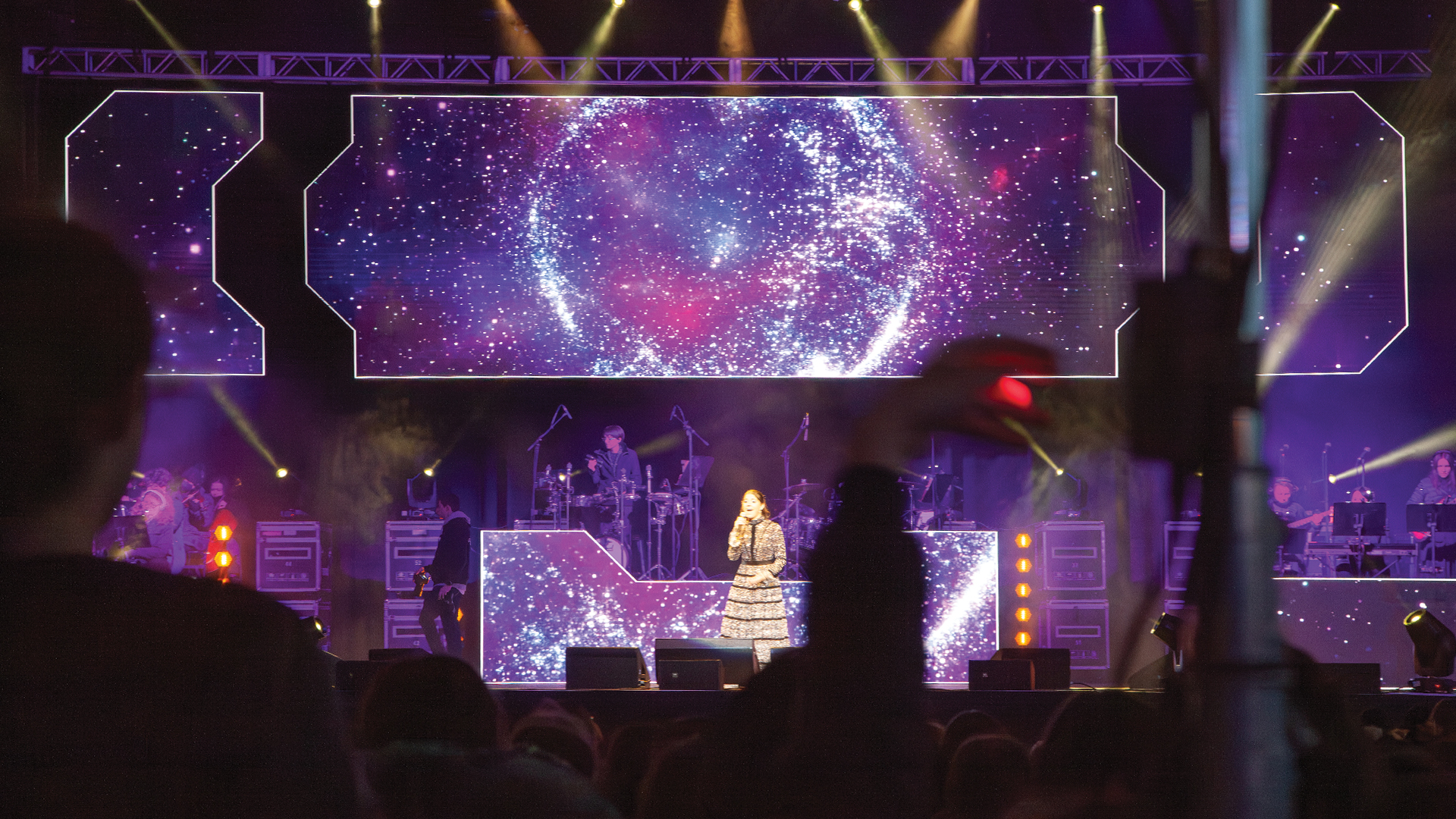
The moment you combine a high-output LED wall with a stage wash designed to illuminate talent standing in front of it, you’ve created one of the most technically unforgiving photographic environments in live event production. Spill light — stage wash, followspots, or scenic lighting bleeding onto the LED surface — is the single most common cause of washed-out LED content in front-of-house environments. It competes with the wall’s own output, destroys the perceived contrast ratio of the video content, and makes even spectacular creative material look flat and institutional. Avoiding it requires a disciplined approach to fixture selection, positioning, and photometric planning that must begin in the design phase, not on the show floor.
Understanding Why Spill Destroys LED Wall Performance
An LED wall’s visual impact is entirely dependent on contrast ratio — the relationship between its brightest pixels and the ambient light level falling on the surface. A Absen A3 Pro panel running at 1,000 nits produces a striking image in a darkened room; that same panel in a room where 200 lux of stage wash is hitting the LED surface is competing against its own ambient illumination. The perceived contrast drops dramatically because every pixel, including the black ones, is receiving additional illumination from the stage wash. The content looks like it’s fighting itself.
This effect is particularly destructive on content with dark backgrounds — the black areas that should provide deep shadow become a dull, washed-out gray. Brompton Technology and other LED processor manufacturers publish technical white papers on ambient light management specifically because it is one of the most common support questions they receive from production teams. The mathematical relationship is unforgiving: to maintain perceived contrast at a given ambient light level, you either reduce the ambient light or increase the panel brightness — and most production environments have hard limits on both.
Fixture Positioning: The Geometry of Spill
Spill light on an LED wall is a geometry problem as much as a photometric one. Stage wash fixtures positioned too high and too close to the wall create spill angles that inevitably illuminate the top sections of the LED surface. Followspots with inadequate iris control or operated by personnel who haven’t been briefed on spill discipline will paint arcs of light across the LED surface every time they track a presenter’s movement. Scenic lighting on wings and borders creates side-spill that clips the edges of LED panels.
The primary positioning discipline is keeping stage wash angles steep — fixtures that light talent from above at steep angles create pools that fall on the talent and the floor, not on the vertical LED surface behind them. ARRI SkyPanel S60-C units or Aputure 600D Pro soft panels rigged tight to the grid at 45-60 degree angles to the stage floor, with appropriately sized barn doors or top hats to control the beam’s vertical spread, can illuminate a presenter cleanly without introducing significant spill on a wall 3-4 meters behind them.
Black Masking and Physical Barriers
When geometry alone cannot solve the spill problem — in venues where rigging positions are limited or where the LED wall extends from floor to grid — physical masking becomes the most reliable solution. Black velour masking hung between the LED wall and the stage wash zone can block spill without affecting the talent’s lighting, provided it’s positioned correctly and isn’t visible to the audience. On smaller stage setups, egg-crate louvers mounted to the front face of LED panels — directing the wall’s own emission toward the audience while blocking incoming light — are a technique borrowed from retail display technology that works surprisingly well for lower-ambient environments.
Scenic design can also serve a masking function. A scenic portal — an architectural frame around the LED wall that creates physical separation between the wall surface and the stage area — casts a shadow on the LED wall that blocks stage wash while providing a clean edge to the visual field. This technique is used extensively in broadcast studio design, where LED walls behind anchor desks are surrounded by scenic elements specifically engineered to block the studio’s key and fill lighting from reaching the screen surface.
The LED Wall’s Own Output as a Lighting Source
An often-overlooked dimension of spill management is the LED wall’s own light output affecting the camera exposure and talent appearance. A high-brightness LED wall running vivid content will backlight and edge-light presenters standing in front of it, creating colored spill on their faces and hair that changes color as the content changes. This is not spill in the traditional sense — it’s the wall itself acting as a light source — but it creates the same visual problem of inconsistent, uncontrolled illumination.
Managing this requires a camera-position-aware lighting design that provides sufficient key light output to overpower the LED wall’s backlight contribution. The key-to-back ratio — the relationship between the talent’s key light level and the light received from the LED wall — should favor the key light by at least 3:1 in most production environments. Brompton’s HDR mode and Novastar’s Hyperion processing allow LED walls to maintain high peak brightness for content while modulating the ambient contribution — but these are tools to complement a well-designed lighting system, not substitutes for one.
Pre-Show Measurement and Documentation
The professional standard for LED wall spill management is lux measurement before the show. A Sekonic L-858D or Konica Minolta CL-200A placed against the LED surface while stage wash is running at show levels gives an objective measurement of ambient illumination hitting the wall. Cross-referencing this figure against the LED wall’s specified brightness setting and the panel’s contrast ratio specification tells you mathematically whether your spill level is acceptable before a single frame of content is displayed.
Document these measurements for every show position and include them in the production file. Venues change between visits; dimmer levels drift; new fixtures get added to rigs. Having baseline measurements lets you identify spill problems before they become visible on camera — and gives you a concrete technical brief for the lighting programmer when adjustments need to be made. In a discipline where most problems are discovered visually on the show day, measurement-driven design is a competitive advantage.
