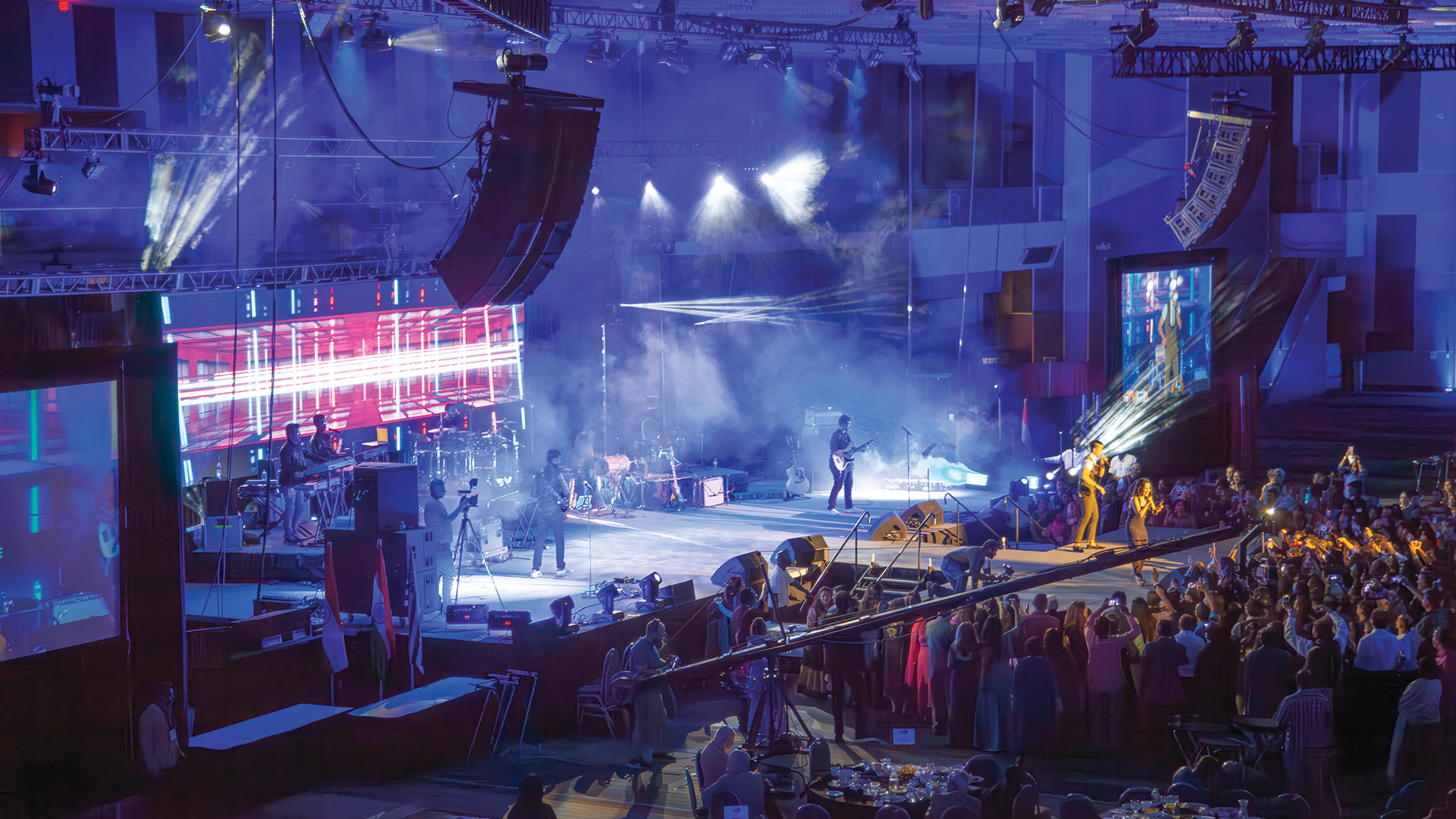
Professional sound reinforcement systems represent decades of acoustic engineering refined to deliver crystal-clear audio to audiences of thousands. These sophisticated assemblies of line arrays, subwoofers, and processing equipment possess an uncanny ability to develop personalities precisely when crews need them most to behave. When PA systems decide to mock their handlers, the resulting audio adventures become the stuff of industry legend.
The Arena Show That Found Its Voice
A headline rock tour arrived at a major European arena with their touring L-Acoustics K1/K2 system—a configuration trusted by the world’s most demanding artists. The system technician conducted standard pre-show routines: pink noise sweeps, phase alignment verification, and SMAART analysis to optimise room response. Everything measured perfectly.
During soundcheck, the main PA hangs began exhibiting what the crew termed ‘spontaneous artistic interpretation.’ The LA-RAK amplifiers powering the system would intermittently add their own sonic contributions—random bursts of white noise, unexpected high-frequency oscillation, and one memorable instance where the entire left hang produced a sound disturbingly similar to laughter.
The front-of-house engineer initially suspected the Avid VENUE S6L console, but swapping to backup showed identical symptoms. The AES/EBU digital audio connections tested flawlessly. Amplifier diagnostics reported nominal operation. Yet the system continued its impromptu comedy routine.
Tracing the History of Sound Reinforcement Rebellion
PA system misbehaviour has accompanied live sound since the technology’s inception. In 1969, Woodstock’s legendary sound system—designed by Bill Hanley—famously struggled against rain, mud, and the limitations of available technology. Hanley’s custom horn-loaded cabinets and McIntosh amplifiers performed admirably given the circumstances, though contemporary accounts describe moments when the system seemed determined to undermine performers.
The development of modern line array technology in the 1990s—pioneered by Christian Heil at L-Acoustics—revolutionised large-scale sound reinforcement. The V-DOSC system introduced wavefront sculpture principles that remain foundational. Yet even these sophisticated designs cannot entirely eliminate the gremlins that inhabit professional audio equipment.
The Festival Main Stage Mutiny
A prestigious summer festival deployed a massive JBL VTX A12 system across their main stage, complemented by VTX S28 subwoofers in cardioid configuration designed to focus low-frequency energy toward the audience while minimising stage bleed. The Crown I-Tech HD amplifiers powering the rig represented the latest in digital amplification technology.
The first headliner’s set began with the subwoofer arrays deciding independently to increase their output by approximately 12dB. The front-of-house position experienced what the engineer described as ‘physical assault by bass’—console faders rattled, drink containers migrated across surfaces, and several crew members reported mild nausea from the infrasonic content.
Simultaneously, the main left hang developed severe comb filtering with its delay tower. Despite verified GPS-based time alignment, the resulting phasing created dead spots where dialogue intelligibility dropped to near zero. The system was, quite literally, laughing at the crew’s attempts to restore coherent coverage.
The Role of Digital Processing in Modern PA Behavior
Contemporary PA systems incorporate extensive digital signal processing that creates both opportunities and vulnerabilities. FIR-based loudspeaker correction, real-time array optimization, and network-distributed processing introduce computational layers that earlier analogue systems lacked.
Systems like Meyer Sound Compass, L-Acoustics Soundvision, and d&b ArrayCalc enable precise acoustic prediction and optimisation. However, these tools require accurate input data—venue dimensions, atmospheric conditions, audience density predictions. Garbage in produces garbage out, and misconfigured prediction software can cause systems to behave in unexpected ways when confronted with real-world conditions that differ from modelled assumptions.
The Corporate Conference Catastrophe
A high-stakes pharmaceutical product launch at a convention centre required pristine speech intelligibility for presentations to 2,000 medical professionals. The audio contractor specified a distributed QSC WideLine WL2102 system with ceiling-mounted delay fills, all controlled via Q-SYS Core processors integrated with the venue’s installed infrastructure.
During the CEO’s keynote address, the system began adding an unwanted echo to every word—not the subtle reverberant tail common in convention halls, but a precise 500-millisecond delay creating an unsettling dual-voice effect. Medical professionals expecting information about breakthrough treatments instead witnessed what appeared to be executive vocal cloning in real-time.
Investigation revealed that the venue’s Dante network had incorrectly routed audio through an auxiliary processing path intended for simultaneous translation. The translation system’s latency buffer added the distinctive delay. Despite extensive pre-event testing, this routing error only manifested when specific wireless microphone channels were activated—channels not used during the abbreviated soundcheck.
Practical Approaches to System Reliability
Preventing PA systems from developing comedic tendencies requires systematic approaches to system design and commissioning. Comprehensive cable testing using analysers like the Behringer CT100 or Whirlwind Tester catches wiring faults before they cause show-stopping failures.
Network architecture demands particular attention in modern audio-over-IP environments. Protocols including Dante, AVB, and AES67 require proper network switch configuration—IGMP snooping, QoS prioritisation, and multicast management all influence system stability. The Audinate Dante Controller application provides essential diagnostic capabilities for networked audio infrastructure.
The Theatre Sound System Showdown
A West End revival of a classic musical employed a sophisticated Meyer Sound LYON system with Galileo GALAXY processors providing immersive audio capabilities. The design featured overhead surround arrays intended to envelope audiences in three-dimensional sonic environments.
Opening night proceeded smoothly until the climactic second-act finale. As the orchestra swelled and the lead performer approached their emotional peak, the overhead system began circulating audio in an unintended pattern—sound spinning around the auditorium like a vinyl record played at the wrong speed. The SpaceMap Go spatial control software had received corrupted cue data from the QLab show control system, triggering a demonstration mode rather than the programmed scene.
Environmental Factors in PA Performance
Professional audio systems respond to environmental conditions in ways that can appear capricious. Temperature affects both loudspeaker performance and the speed of sound—a venue warming from doors-open to packed audience can shift delay timing by several milliseconds, enough to create audible phase interference.
Humidity changes air density, altering high-frequency absorption characteristics. Systems calibrated in empty venues often require EQ adjustments when audiences absorb acoustic energy that hard surfaces previously reflected. Sophisticated measurement tools including SMAART, Room EQ Wizard, and Systune help engineers anticipate and compensate for these variables.
The PA systems that laugh at their crews ultimately provide valuable education disguised as frustration. Each mysterious behaviour, once diagnosed, adds to the collective expertise of the professional audio community. The stories shared over post-show meals and industry gatherings transmit hard-won wisdom to younger engineers, ensuring that the same systems won’t have the last laugh twice. Until, of course, they find entirely new ways to mock the humans who dare to deploy them.
