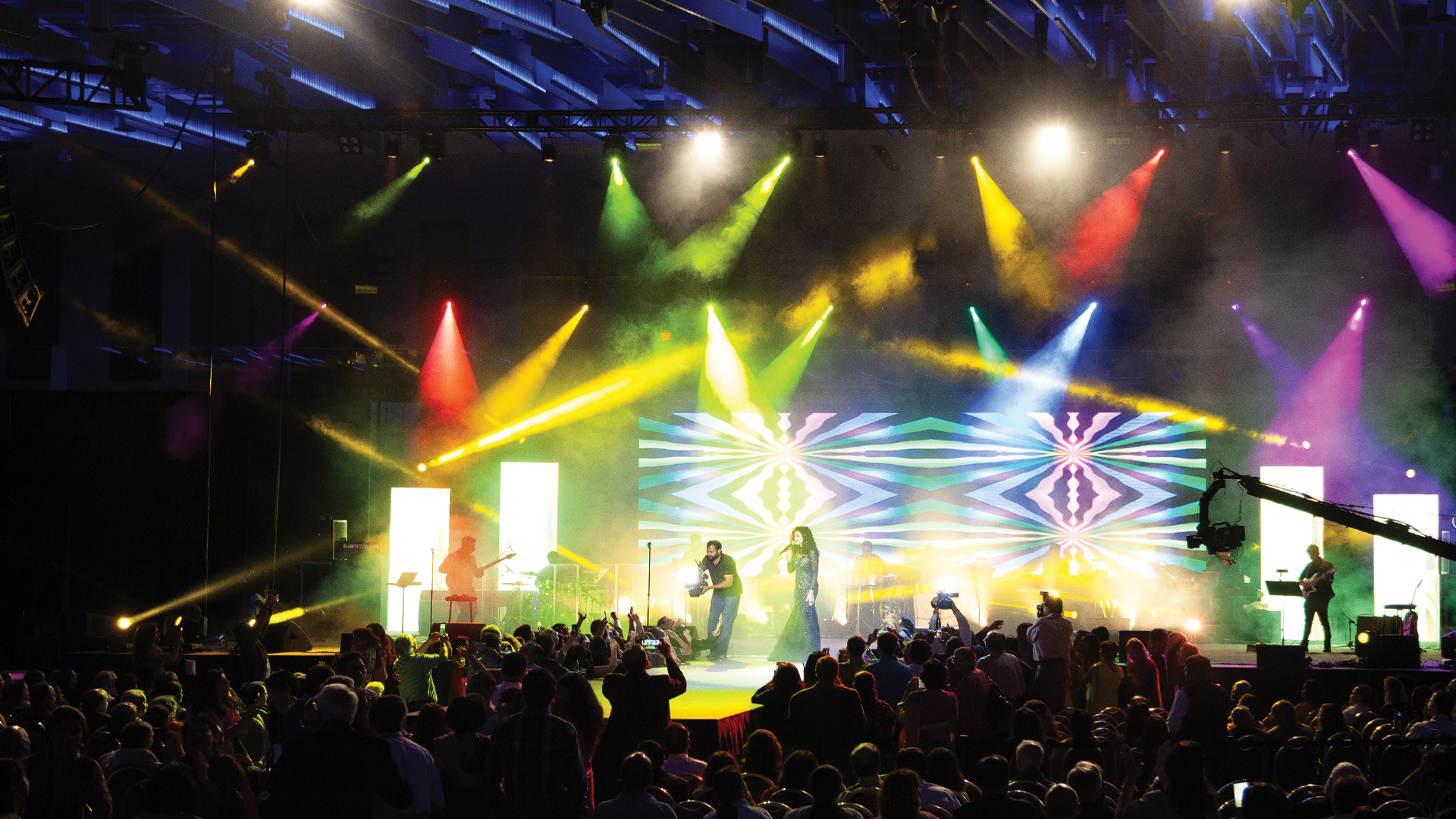
The speaker reaches her pivotal moment the slide behind her shifts to a single data point that changes everything and simultaneously, a warm pool of light tightens around her while the surrounding stage dims imperceptibly. The audience doesn’t consciously notice the lighting change; they simply find themselves irresistibly focused on the revelation unfolding before them. This is accent lighting deployed with surgical precision, an invisible hand directing collective attention without ever announcing its presence.
The Neuroscience of Visual Attention
Human visual systems evolved to detect contrast and movement as survival mechanisms—noticing the tiger against the grass or the berry against the leaves. Modern lighting designers exploit these hardwired responses to direct focus within controlled environments. Research conducted at the University of Toronto’s Vision Sciences department demonstrated that brightness differentials as small as fifteen percent between focal points and backgrounds capture attention without triggering conscious awareness of the manipulation.
The peripheral vision system proves particularly susceptible to motion cues. While central vision processes detail and color, peripheral sensors specialize in detecting movement and contrast changes. Accent lighting transitions lasting between half a second and two seconds activate peripheral attention mechanisms, drawing eyes toward brightening areas without the jarring quality of instantaneous changes. This timing window, documented extensively in theatrical lighting literature, provides the foundation for natural-feeling attention guidance.
Fixture Selection for Accent Applications
Not all lighting instruments serve accent purposes equally. The tight beam control required for focused attention pools demands fixtures with precise optical systems equipment like the Martin ERA 600 Profile or the ETC ColorSource Spot. These instruments feature adjustable shuttering systems that carve light into precise shapes, preventing spill onto areas intended to remain in relative shadow.
LED technology has transformed accent lighting possibilities through color mixing capabilities impossible with conventional fixtures. The ability to shift color temperature in real-time allows designers to create psychological emphasis through warmth variation. Corporate presentations increasingly use this technique, warming accent pools during emotional moments and cooling them for analytical content, creating subconscious associations that reinforce messaging without explicit statement.
The Three-Zone Intensity Model
Professional lighting designers structure accent systems around three intensity zones. The primary zone where focal attention should rest operates at one hundred percent of desired maximum intensity. The secondary zone maintains ambient visibility at approximately sixty percent of primary intensity, providing context without competition. The tertiary zone drops to roughly thirty percent, creating depth perception while allowing audiences to locate exits and personal belongings without fumbling in darkness.
Transitions between zones during events follow consistent ratios rather than arbitrary adjustments. When shifting focus from a speaker to a reveal, the former primary zone drops to secondary levels while the new focus area rises to primary intensity. This proportional approach, maintained through careful programming in lighting control systems, creates smooth attention transitions that feel organic rather than mechanically imposed.
Color Temperature as Emotional Accent
The Kelvin scale provides a framework for understanding color temperature‘s psychological effects. Warm temperatures around 2700K create intimate, comfortable atmospheres associated with firelight and sunset effective for storytelling segments and emotional appeals. Cooler temperatures approaching 5600K suggest daylight clarity, lending analytical credibility to data presentations and technical demonstrations. The GrandMA3 lighting console family excels at storing these color temperature associations as presets, allowing operators to invoke specific emotional states through single-button recalls.
Transition speed between color temperatures dramatically impacts perceived emotional shifts. Rapid changes feel jarring and theatrical, appropriate for entertainment contexts but disruptive in corporate environments. Gradual transitions spanning three to five seconds allow audiences to adapt without conscious awareness of the shift, making them ideal for business presentations where attention should remain on content rather than production values.
Gobo Patterns and Textured Accents
Metal or glass patterns inserted into profile fixtures project textured light that adds visual interest without literal imagery. Companies like Rosco and Apollo Design produce thousands of gobo patterns ranging from abstract textures to architectural details. When deployed as accent elements rather than primary focus, these patterns create depth and dimensionality that photographs exceptionally well while maintaining appropriate restraint for corporate environments.
The rotation of gobo patterns through motorized fixtures adds subtle motion that captures attention without overwhelming content. Slow rotation speeds one complete revolution every thirty to sixty seconds create atmospheric movement that registers subconsciously. Faster rotations become distracting, shifting audience focus from intended content to the production elements themselves. The skill lies in finding rotation speeds that enhance without competing.
Integration With Presentation Content
Maximum accent lighting impact occurs when changes coordinate with presentation content. Modern integration approaches use triggers embedded within PowerPoint or Keynote files, transmitted through systems like Companion or WATCHOUT to lighting consoles. When a presenter advances to a crucial slide, the lighting automatically adjusts without requiring manual operator intervention eliminating timing variations while ensuring consistent emphasis on key moments.
The technical implementation involves MIDI or OSC protocol transmission between presentation computers and lighting control networks. Setup requires advance coordination between content creators and lighting programmers, specifying exactly which slides demand accent changes and what those changes should accomplish. This collaborative workflow, increasingly standard at high-end corporate events, produces seamless integration that elevates both content and production value.
Measurement and Calibration Approaches
Light meters from manufacturers like Sekonic provide objective measurements that remove guesswork from accent calibration. Before events, technical directors capture baseline readings at key positions, establishing reference values that inform programming decisions. During technical rehearsals, these measurements verify that intensity relationships match design intentions, allowing corrections before audiences arrive and subjective judgments become impossible.
Documentation of successful accent configurations creates institutional knowledge that improves future productions. When particular intensity ratios and transition timings prove effective for specific event types, recording these parameters allows reproduction without rediscovery. This accumulated wisdom distinguishes production companies with depth from those constantly reinventing approaches that industry veterans solved years ago.
