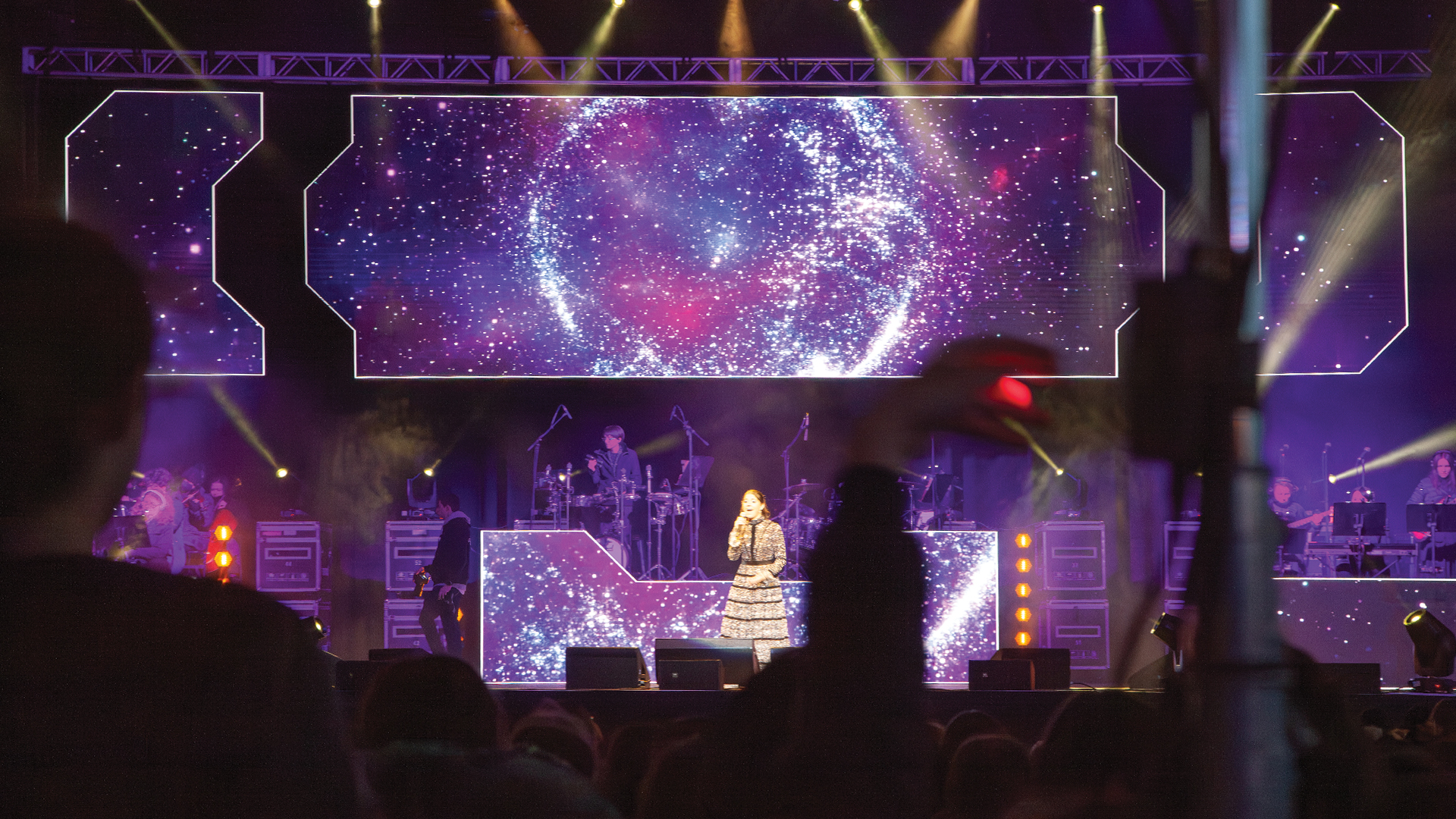
The first time an audience enters a venue and looks up to see an infinite starfield stretching above them pixels indistinguishable from the void of space the investment in overhead LED technology justifies itself instantly. What was once a technical limitation the ceiling that obscured rigging, trapped heat, and defined spatial boundaries becomes a creative canvas extending the visual environment beyond horizontal planes. LED ceiling installations have transformed from experimental novelties into essential components of immersive production design, bringing unique engineering challenges and creative possibilities that production teams must understand thoroughly before attempting implementation.
Structural Considerations: Weight and Load Distribution
Overhead LED installations demand rigorous structural engineering that accounts for both static loads and dynamic safety factors. LED panels weigh considerably more per square meter than traditional scenic materials a typical 500x500mm panel might weigh 8-12kg, meaning a 10×10 meter ceiling comprises over 400 panels totaling 3,200-4,800kg before cables, rigging hardware, and structural support. Venue rigging points designed for lighting loads may not accommodate these concentrated weights without verification by qualified engineers. The ESTA Technical Standards Program provides guidance on rigging practices, but LED ceiling installations often require project-specific engineering review.
Secondary retention systems provide redundancy that safety demands. If a primary mounting point fails, backup systems must prevent panels from falling onto performers or audiences below. Steel safety cables rated for dynamic loads connect each panel independently to the support structure, positioned to arrest falls before panels can strike anyone beneath. Arena Rigging and Gerriets manufacture certified safety cable systems designed for overhead applications. The combined weight of safety cables themselves adds to total load calculations a detail overlooked in preliminary estimates that can create problems during implementation.
Historical Evolution of Overhead LED Applications
The use of video elements overhead evolved through several technological generations. Early concert tours in the 1990s experimented with projection onto fabric scrims positioned above stages, creating ethereal effects that extended visual design vertically. The limitations of projection brightness and the challenges of projector positioning constrained these applications to atmospheric effects rather than vivid imagery. U2’s PopMart tour in 1997 pushed boundaries with its massive LED screen at the time, the largest touring video display ever deployed—though the technology remained vertical rather than overhead.
True overhead LED arrays emerged as panel weights decreased and pixel pitches tightened. Virtual production stages beginning around 2019 demonstrated that LED volumes could encompass performers entirely, including overhead elements that served as both visual environment and practical lighting source. Studios like Industrial Light & Magic’s StageCraft pioneered ceiling LED integration for film production, proving that the technology could deliver broadcast-quality images from any angle. Event production adapted these techniques for corporate and entertainment applications where complete environmental immersion enhances brand experiences.
Panel Selection for Overhead Applications
Not all LED panels suit overhead installation equally. Viewing angle specifications matter more critically when audiences look upward—panels designed for direct front viewing may exhibit significant brightness falloff at the acute angles inherent to overhead positions. Products from ROE Visual (Carbon CB5), Absen (KL II Series), and INFiLED offer models optimized for curved and angled installations where viewing geometry varies throughout the display surface.
Weight per panel directly impacts total load and cost lighter panels require less structural support and reduce rigging complexity. Carbon fiber frames from manufacturers like ROE Visual achieve significant weight reduction compared to traditional aluminum construction, though at premium cost. The tradeoff calculation considers venue rigging capacity, installation timeline, and budget constraints. A ceiling design that fits within existing rigging capacity using lighter panels may cost more in product but save substantially on structural engineering and venue modifications.
Cable Management: The Hidden Challenge
Power and data distribution for overhead LED arrays presents logistical challenges that floor-based installations avoid. Each panel requires power and data connections, creating cable runs that must reach elevated positions without compromising the visual ceiling effect. Top-loaded designs route cables from above, hiding connections behind the LED surface ideal when catwalks or technical grids provide access. Rear-serviceable designs require space behind panels for technician access, adding depth to the overall installation that affects trim height calculations.
Fiber optic distribution solves distance and weight challenges that copper creates. A single fiber cable can replace dozens of copper data cables, dramatically simplifying cable management while extending possible run lengths. Brompton Technology processors support fiber output to receiving cards, enabling centralized processing with minimal cable infrastructure to the ceiling. Power distribution requires heavier conductors that cannot convert to fiber, but careful planning minimizes power cable runs through strategic positioning of distribution points within the ceiling structure itself.
Content Creation for Overhead Displays
Content designed for vertical screens doesn’t translate directly to overhead viewing. Audience perspective dramatically affects how imagery reads—text becomes illegible at extreme angles, and motion that works on front-facing screens can create disorientation when viewed from below. Abstract patterns, atmospheric environments, and organic textures tend to succeed overhead where literal content often fails. Clouds drifting slowly, water rippling above, geometric patterns pulsing with music—these content approaches leverage the ceiling position’s strengths without fighting its perceptual challenges.
Real-time rendering engines like Notch, TouchDesigner, and Unreal Engine enable content that responds to music, performer position, or other inputs dynamically. A ceiling that pulses with bass frequencies or shifts color based on audience energy creates immersive experiences impossible with pre-rendered content. disguise media servers integrate with these engines while handling the output mapping required for complex ceiling geometries—curved surfaces, irregular shapes, and panels at varying angles all require sophisticated mapping to display content correctly.
Thermal Management Overhead
Heat rises—a fundamental physics reality that creates thermal challenges for overhead LED installations. Panels designed for vertical mounting assume ambient air at certain temperatures; mounting them horizontally above hot lighting fixtures and body heat rising from audiences creates conditions outside design parameters. Active ventilation systems move air across panel surfaces, preventing heat buildup that can damage components or trigger thermal protection shutdowns. The structural framework supporting LED ceiling arrays often incorporates HVAC integration, with ducted airflow designed into the support system.
Temperature monitoring throughout operation identifies developing problems before they cause failures. Brompton Tessera processors report panel temperatures through their monitoring interfaces, enabling operators to track thermal performance in real-time. Setting alarm thresholds that trigger before critical temperatures enables intervention—reducing brightness, increasing ventilation, or addressing airflow obstructions—that prevents damage. Productions in desert climates or enclosed venues with limited HVAC capacity must pay particular attention to thermal management throughout planning and operation.
Installation and Service Access
Reaching overhead panels for installation, adjustment, and service requires access solutions that balance safety with efficiency. Scissor lifts and boom lifts enable technicians to reach elevated positions, but their footprints may conflict with staging or scenic elements below. Some installations incorporate catwalk systems above the LED ceiling that provide permanent access without equipment—ideal for permanent installations but rarely practical for temporary event production. Genie and JLG offer compact lift models that minimize floor impact while reaching necessary heights.
Building ceiling assemblies on the ground and flying completed sections reduces work at height—a strategy that improves both safety and speed. Pre-assembled sections incorporating multiple panels with cabling complete arrive at trim height ready for connection to adjacent sections. This approach requires rigging capacity to lift heavier completed assemblies rather than individual panels, but the efficiency gains often justify the structural requirements. CM Lodestar and Columbus McKinnon hoists rated for the completed section weights enable controlled lifts that position assemblies precisely.
Integration with Lighting Systems
LED ceilings can serve as lighting sources as well as display surfaces—a capability virtual production pioneered that live events increasingly exploit. Programming white or color output across ceiling areas provides wash lighting that eliminates conventional fixtures in some applications. The distributed nature of thousands of LED pixels creates exceptionally soft light that wraps around subjects without the harshness of point sources. However, the precision control that conventional fixtures provide—focus, intensity, color—requires different approaches when lighting comes from LED surfaces.
Coordinating content design with lighting requirements demands collaboration between disciplines that traditionally operate independently. A ceiling displaying bright white during one segment provides ambient light that affects presenter illumination; transitioning to dark starfield removes that contribution entirely. Lighting designers must understand content programming, while content designers must consider lighting implications of their choices. Productions that achieve this integration successfully—where ceiling content enhances rather than complicates lighting design—demonstrate the creative potential of treating all visual elements as unified systems.
Budget and Timeline Implications
LED ceiling installations cost substantially more than equivalent vertical screen area due to structural requirements, specialized panels, and installation complexity. Budget planning must account for engineering review, custom framing fabrication, extended installation time, and the access equipment required for overhead work. A realistic cost expectation might run 2-3x the cost of equivalent vertical installation—a multiplier that varies based on venue conditions and design complexity. Preliminary budgets that underestimate these factors create problems when actual costs emerge.
Installation timelines extend similarly. Work at height proceeds more slowly than floor-level assembly, with safety protocols requiring additional time for lift operation, tool management, and personnel positioning. A ceiling that might seem to require similar panel count to a backdrop will take significantly longer to install. Building adequate timeline into production schedules prevents the compressed installation windows that lead to safety shortcuts or incomplete testing. The most impressive LED ceiling becomes liability rather than asset if rushed installation compromises safety or reliability.
LED ceiling installations represent the frontier of immersive event design—environments that surround audiences completely, erasing the boundaries between stage and auditorium, performer and viewer. The technical challenges are substantial but solvable with proper engineering, planning, and execution. Productions that master these techniques create experiences impossible through any other means: starfields that attendees swear are real, skies that shift with narrative, environments that transform fundamentally throughout events. The investment in getting overhead LED right—structurally, visually, operationally—pays dividends in audience impact that defines events as extraordinary rather than merely competent.
